white-space CSS property - CSS | MDN
The white-space CSS property sets how white space inside an element is handled.
MDN Web Docs · developer.mozilla.org [1]
html [2] can preserve newline \n characters by styling an element with white-space: pre-wrap;
pre-wrap
Sequences of white space are preserved. Lines are broken at newline characters, at
, and as necessary to fill line boxes.
References:
[1]: https://developer.mozilla.org/en-US/docs/Web/CSS/white-space
[2]: /html/
Publishing rhythm
htmx ~ The htmx Response Targets Extension Extension
htmx gives you access to AJAX, CSS Transitions, WebSockets and Server Sent Events directly in HTML, using attributes, so you can build modern user interfaces with the simplicity and power of hypert...
htmx.org [1]
The htmx [2] response-targets extension allows me to respond to errors from the backend and do normal htmx swaps.
Note
by default htmx will only swap on 200 and 300 responses
Load the extension in head
<script src="https://unpkg.com/[email protected]/dist/ext/response-targets.js"></script>
Use the extension on an endpoint that might return a 400.
<div hx-ext="response-targets">
<div id="response-div"></div>
<button hx-post="/register"
hx-target="#response-div"
hx-target-5*="#serious-errors"
hx-target-404="#not-found">
Register!
</button>
<div id="serious-errors"></div>
<div id="not-found"></div>
</div>
References:
[1]: https://htmx.org/extensions/response-targets/
[2]: /htmx/
How to Restart All Pods in a Kubernetes Namespace | Boot.dev
Where I work, we use a repo-per-namespace setup and so it often happens that I want to restart all pods and deployments in a single Kubernetes namespace. Maybe I want to see the startup logs, or ma...
Boot.dev · blog.boot.dev [1]
As of kubernetes 1.15 there is an easy way to restart all pods in a deployment.
kubectl -n {NAMESPACE} rollout restart deploy
Thanks Lane give him a follow @wagslane [2]
References:
[1]: https://blog.boot.dev/open-source/how-to-restart-all-pods-in-a-kubernetes-namespace/
[2]: https://twitter.com/wagslane
TIL how to display the list of nfs mounts on your network.
showmount -e
You can even look for mounts of other machines on your network.
showmount -e <hostname>
To allow access only to the
{
  "Version": "2012-10-17",
  "Statement": [
    {
      "Effect": "Allow",
      "Action": [
        "admin:*"
      ]
    },
    {
      "Effect": "Allow",
      "Action": [
        "kms:*"
      ]
    },
    {
      "Effect": "Allow",
      "Action": [
        "s3:*"
      ],
      "Resource": [
        "arn:aws:s3:::<bucket>",
        "arn:aws:s3:::<bucket>/*"
      ]
    }
  ]
}
You can inspect sqlite tables with the sqlite shell.
note that you get into the shell with
sqlite3 database.db
.tables
I also learned that .tables, .index and .schema are helper functions that
query the sqlite_master table on the main database.
Here is an output from my redka database. The sqlite_master table contains all the sqlite objects type, name, tbl_name, rootpage, and sql to create them.
❯ sqlite3 database.db "SELECT * from sqlite_master;"
table|rkey|rkey|2|CREATE TABLE rkey (
    id       integer primary key,
    key      text not null,
    type     integer not null,
        version  integer not null,
    etime    integer,
        mtime    integer not null
)
index|rkey_key_idx|rkey|3|CREATE UNIQUE INDEX rkey_key_idx on rkey (key)
index|rkey_etime_idx|rkey|4|CREATE INDEX rkey_etime_idx on rkey (etime)
where etime is not null
trigger|rkey_on_type_update|rkey|0|CREATE TRIGGER rkey_on_type_update
before update of type on rkey
for each row
when old.type is not new.type
begin
    select raise(abort, 'key type mismatch');
end
table|rstring|rstring|5|CREATE TABLE rstring (
    key_id integer not null,
    value  blob not null,

    foreign key (key_id) references rkey (id)
          on delete cascade
)
index|rstring_pk_idx|rstring|6|CREATE UNIQUE INDEX rstring_pk_idx on rstring (key_id)
view|vstring|vstring|0|CREATE VIEW vstring as
  select
    rkey.id as key_id, rkey.key, rstring.value,
        datetime(etime/1000, 'unixepoch') as etime,
        datetime(mtime/1000, 'unixepoch') as mtime
  from rkey join rstring on rkey.id = rstring.key_id
  where rkey.type = 1
    and (rkey.etime is null or rkey.etime > unixepoch('subsec'))
table|rhash|rhash|7|CREATE TABLE rhash (
    key_id integer not null,
    field text not null,
    value blob not null,

    foreign key (key_id) references rkey (id)
      on delete cascade
)
index|rhash_pk_idx|rhash|8|CREATE UNIQUE INDEX rhash_pk_idx on rhash (key_id, field)
index|rhash_key_id_idx|rhash|9|CREATE INDEX rhash_key_id_idx on rhash (key_id)
view|vhash|vhash|0|CREATE VIEW vhash as
  select
    rkey.id as key_id, rkey.key, rhash.field, rhash.value,
        datetime(etime/1000, 'unixepoch') as etime,
        datetime(mtime/1000, 'unixepoch') as mtime
  from rkey join rhash on rkey.id = rhash.key_id
  where rkey.type = 4
    and (rkey.etime is null or rkey.etime > unixepoch('subsec'))
With the liscense changes to redis there are several new forks out there. One that I am particularly interested in is redka.
curl https://i.jpillora.com/nalgeon/redka | bash
chmod +x redka
./redka database.db
We now have redis running on port 6379 that we can connect to with a redis client. And we have a sqlite database that we can inspect.
❯ sqlite3 database.db "SELECT name FROM sqlite_master;"
rkey
rkey_key_idx
rkey_etime_idx
rkey_on_type_update
rstring
rstring_pk_idx
vstring
rhash
rhash_pk_idx
rhash_key_id_idx
vhash
We can look at the values in the vstring table.
sqlite3 database.db "SELECT * from vstring;"
1|hi|hello there you||2024-04-17 01:46:26
The main system that I am concerned about is my arch BTW machine. I found a great article from the official archlinux site covering it.
For my machine I am concerned with this line.
The xz packages prior to version 5.6.1-2 (specifically 5.6.0-1 and 5.6.1-1) contain this backdoor.
I checked my xz package with AUR.">paru, and I am good.
paru -Qii zx
AUR.">paru has some nice features that I rarely use, and hav to look up when I need them. Here are two commands to help with dependency management.
❯ paru -Qii nodejs
Name            : nodejs
Version         : 21.7.2-1
Description     : Evented I/O for V8 javascript
Architecture    : x86_64
URL             : https://nodejs.org/
Licenses        : MIT
Groups          : None
Provides        : None
Depends On      : icu  libuv  libnghttp2  libnghttp3  libngtcp2  openssl  zlib  brotli  c-ares
Optional Deps   : npm: nodejs package manager [installed]
Required By     : node-gyp  nodejs-nopt  npm  semver
Optional For    : None
Conflicts With  : None
Replaces        : None
Installed Size  : 46.86 MiB
Packager        : Felix Yan <[email protected]>
Build Date      : Thu 04 Apr 2024 05:11:09 AM CDT
Install Date    : Mon 15 Apr 2024 07:27:02 AM CDT
Install Reason  : Installed as a dependency for another package
Install Script  : No
Validated By    : Signature
Backup Files    : None
Extended Data   : pkgtype=pkg
You can check all the packages depended on by nodejs by running the following. This is everything from all of the repos you have configured, not what you have installed.
❯ pactree --reverse --sync --depth 1 nodejs

nodejs
├─acorn
├─ansible-language-server
├─asar
├─babel-cli
├─babel-core
├─bash-language-server
├─blinksocks
├─bower
├─browserify
├─coffeescript
├─dot-language-server
├─emscripten
├─eslint
├─eslint-language-server
├─eslint_d
├─gitlab
├─gnomon
├─grunt-cli
├─gtop
├─gulp
├─hedgedoc
├─jake
├─markdownlint-cli2
├─marked
├─marked-man
├─matrix-appservice-irc
├─modclean
├─node-gyp
├─nodejs-emojione
├─nodejs-material-design-icons
├─nodejs-nopt
├─nodejs-source-map
├─nodejs-yaml
├─npm
├─openui5
├─pm2
├─prettier
├─pyright
├─rapydscript-ng
├─s3rver
├─semver
├─serverless
├─stylelint
├─stylus
├─svelte-language-server
├─tailwindcss-language-server
├─ts-node
├─typescript
├─typescript-svelte-plugin
├─uglify-js
├─vscode-css-languageserver
├─vscode-html-languageserver
├─vscode-json-languageserver
├─vue-language-server
├─vue-typescript-plugin
├─wasm-bindgen
├─web-ext
├─wrangler
├─yaml-language-server
├─yarn
Changelog Master Feed
Your one-stop shop for all Changelog podcasts.
Changelog · changelog.com [1]
Jerod (It’s ya boi) and Adam are my favorite tech news nerds, and have the sickest podcasts in tech. Yes plural podcasts they run seven podcasts maybe more. If you want it short and sweet they got the best 15 minutes of tech news each week this is it. My favorite is Ship it, sad to see Gerhard go, but Justin and Autumn are crushing it. Every episode is highly polished and surrounded by the sickest beats in podcasting.
Subscribe to one pod if you want, but I recommend collecting them all with the master feed.
⭐⭐⭐⭐⭐
References:
[1]: https://changelog.com/master
MarkdownDown
Convert any webpage to a clean markdown w/ images downloaded.
MarkdownDown · markdowndown.vercel.app [1]
Small web app to convert html [2] into markdown. Pretty cool idea. I actually want to look into this for reader and see how well it would work. Right now I am just pulling descriptions, but maybe I can pull full web pages, and keep the full intent of the first 200 words or so in the cards.
References:
[1]: https://markdowndown.vercel.app/
[2]: /html/
Boston Dynamics’ new humanoid moves like no robot you’ve ever seen
All-electric, 360° joints give the new Atlas plenty of inhuman movements.
Ars Technica · arstechnica.com [1]
Award for the creepiest way to stand up a robot from lying flat.
References:
[1]: https://arstechnica.com/gadgets/2024/04/boston-dynamics-debuts-humanoid-robot-destined-for-commercialization/
Rug pull, not cool! (Changelog & Friends #40)
If Changelog News had an extended edition, this might be it! Jerod & Adam discuss Hashicorp's Cease and Desist letter, Redis getting forked, Boston Dymanics' scary cool new robot, Justin Searls' ex...
Changelog · changelog.com [1]
Five star episode with Jarod and Adam shootin the crap.
The massive Cease and Desist [2]
Sucks that the guest had to back out, what a wild world 2024 is. Filled with license and pricing changes.
From Vim to Zed [3]
Interesting to hear the journey into zed, way to go Thorston diving all the way into working at zed.
Boston Dynamics’ new Atlas [4]
I later saw this through a YT short, and man does it hold up to the creepy level that they described.
MarkdownDown [5]
This is a legit cool service, that converts html [6] into markdown
References:
[1]: https://changelog.com/friends/40
[2]: https://opentofu.org/blog/our-response-to-hashicorps-cease-and-desist/
[3]: https://registerspill.thorstenball.com/p/from-vim-to-zed
[4]: https://arstechnica.com/gadgets/2024/04/boston-dynamics-debuts-humanoid-robot-destined-for-commercialization
[5]: https://markdowndown.vercel.app/
[6]: /html/
![[none]]
---
apiVersion: argoproj.io/v1alpha1
kind: Application
metadata:
name: kanboard
namespace: argocd
spec:
project: default
destination:
namespace: kanboard
server: 'https://kubernetes.default.svc'
source:
path: kanboard
repoURL: 'https://github.com/waylonwalker/homelab-argo'
targetRevision: HEAD
syncPolicy:
automated:
prune: true
I recently had to update my copier-gallery command to trust my own templates because some of them have shell scripts that run afterwards. Be warned that this could be a dangerous feature to run on random templates you get off the internet, but these are all mine, so if I wreck it its my own fault.
copier copy --trust <template> <destination>
All the the copier copy api can be found with help.
❯ copier copy --help
copier copy 8.3.0

Copy from a template source to a destination.

Usage:
    copier copy [SWITCHES] template_src destination_path

Hidden-switches:
    -h, --help                         Prints this help message and quits
    --help-all                         Prints help messages of all sub-commands and quits
    -v, --version                      Prints the program's version and quits

Switches:
    -C, --no-cleanup                   On error, do not delete destination if it was
                                       created by Copier.
    --UNSAFE, --trust                  Allow templates with unsafe features (Jinja
                                       extensions, migrations, tasks)
    -a, --answers-file VALUE:str       Update using this path (relative to
                                       `destination_path`) to find the answers file
    -d, --data VARIABLE=VALUE:str      Make VARIABLE available as VALUE when rendering the
                                       template; may be given multiple times
    -f, --force                        Same as `--defaults --overwrite`.
    -g, --prereleases                  Use prereleases to compare template VCS tags.
    -l, --defaults                     Use default answers to questions, which might be
                                       null if not specified.
    -n, --pretend                      Run but do not make any changes
    -q, --quiet                        Suppress status output
    -r, --vcs-ref VALUE:str            Git reference to checkout in `template_src`. If you
                                       do not specify it, it will try to checkout the
                                       latest git tag, as sorted using the PEP 440
                                       algorithm. If you want to checkout always the
                                       latest version, use `--vcs-ref=HEAD`.
    -s, --skip VALUE:str               Skip specified files if they exist already; may be
                                       given multiple times
    -w, --overwrite                    Overwrite files that already exist, without asking.
    -x, --exclude VALUE:str            A name or shell-style pattern matching files or
                                       folders that must not be copied; may be given
                                       multiple times
Manual Upgrades | K3s
You can upgrade K3s by using the installation script, or by manually installing the binary of the desired version.
docs.k3s.io [1]
You can give k3s an install channel to install stable, latest, or specific versions like 1.26. This is handy to make sure that you install the same version on all of your workers.
curl -sfL https://get.k3s.io | INSTALL_K3S_CHANNEL=latest <EXISTING_K3S_ENV> sh -s - <EXISTING_K3S_ARGS>
References:
[1]: https://docs.k3s.io/upgrades/manual
Today I accidentally ran f2 in ipython to discover that it opens your $EDITOR!
I use this feature quite often in zsh, it is bound to <c-e> for me, and since
I have my environment variable EDITOR set to nvim it opens nvim when I hit
<c-e>. Today I discovered that Ipython has this bound to F2. If you know
how to set it to <c-e> let me know I’ve tried, a lot.
export EDITOR=nvim
ipython
<F2>
better yet add export EDITOR=nvim to your .zshrc
# ~/.zshrc
export EDITOR=nvim
Devin's Upwork "side hustle" exposed (Changelog News #90)
YouTuber "Internet of Bugs" breaks down why AI "software engineer" Devin is no Upwork hero, Redka is Anton Zhiyanov's attempt to reimplement Redis with SQLite, OpenTofu issues its response to Hashi...
Changelog · changelog.com [1]
Damn 2024 is such a shit show, now Devin seems to be out as a complete scam. It’s really teaching us to have skepticism for what you find on the internet. Turns out that when broken down frame by frame much of the description in the video was a straight up lie. Personally it seemed quite plausible that it was percentage points better than the competition, but I was not holding my breath for it to be a hands off engineer.
References:
[1]: https://changelog.com/news/90
External Link
stackoverflow.com [1]
I learned about the sqlite_master table from this stack overflow answer. This helps make a lot of sense to how sqlite works. The master table contains all the sqlite objects and the sql to create them.
The .tables, and .schema “helper” functions don’t look into ATTACHed databases: they just query the SQLITE_MASTER table for the “main” database. Consequently, if you used
sqlite3 database.db "SELECT * from sqlite_master;"
References:
[1]: https://stackoverflow.com/questions/82875/how-can-i-list-the-tables-in-a-sqlite-database-file-that-was-opened-with-attach#answer-83195
Redirecting
15r10nk.github.io [1]
This is a cool snapshot testing tool that automatically creates, and updates test values for you.
Starting with some test code.
from inline_snapshot import snapshot
def something():
return 1548 * 18489
def test_something():
assert something() == snapshot()
now if I run pytest my tests will fail because my assert will fail, but if I run pytest --inline-snapshot=create it will fill out my snapshot values and the file will then look like this.
from inline_snapshot import snapshot
def something():
return 1548 * 18489
def test_something():
assert something() == snapshot(28620972)
References:
[1]: https://15r10nk.github.io/inline-snapshot/
I’ve really been enjoying using sqlmodel for my projects that need a database. One thing that I definitely lacked on for too long was indexing my database. I hit a point with one database where it was taking 7s for pretty simple paginated queries to return 10 records.
For every field that you will be querying on, you can create an index, by
setting it equal to Field(index=True)
class Hero(SQLModel, table=True):
    id: int | None = Field(default=None, primary_key=True)
    name: str = Field(index=True)
    secret_name: str
    age: int | None = Field(default=None, index=True)
example courtesy of the docs
Note
primary keys are indexed by default.
The docs cover this pretty well, and in quite depth - Optimizing Queries
inline-snapshot is a new tool that I am trying out for python testing. It
takes snapshots of your outputs and places them inline with the test.
Here is the most basic starter.
import inline_snapshot

def test_one():
    assert 1 == snapshot()
Now when I run pytest my tests will fail because my assert has no value, but if I
run pytest --inline-snapshot=create it will fill out my snapshot values and the
file will then look like this.
import inline_snapshot

def test_one():
    assert 1 == snapshot(1)
It also works with pydantic models.
class MyModel(BaseModel):
    name: str
    age: int
    nickname: str | None = None


def test_my_model_instance():
    assert MyModel(name="Waylon", age=1) == snapshot(MyModel(name="Waylon", age=1))


def test_my_model_fields():
    me = MyModel(name="Waylon", age=1, nickname='Waylon')
    assert me.name == snapshot("Waylon")
    assert me.age == snapshot(1)
    assert me.nickname == snapshot("Waylon")
nalgeon [1] has done a fantastic job with redka [2]. Highly recommend taking a look.
Redis re-implemented with SQLite
References:
[1]: https://github.com/nalgeon
[2]: https://github.com/nalgeon/redka
GitHub - nalgeon/redka: Redis re-implemented with SQL
Redis re-implemented with SQL. Contribute to nalgeon/redka development by creating an account on GitHub.
GitHub · github.com [1]
Redka a sick new redis compatable api, that uses sqlite as its backend datastore. It feels lightweight to use as it is a single small binary. Data does not have to fit into memory as it uses sqlite to store data.
References:
[1]: https://github.com/nalgeon/redka
Today I learned how to VACUUM a sqlite database and cut its size in about half. It’s a database that I have had running for quite awhile and has some decent traffic on it.
Why is it important to do a VACUUM? In short its becuase the file system gets fragmented with as data is updated. On delete the files are removed from the database and marked as available for reuse in the filesystem, but the space is not reclaimed.
To VACUUM a database, run the following sql command. You can do it right form
the sqlite shell by running sqlite3.
You will need about double the current size of the database as free space to do the VACUUM, you need space for a full copy, journaling or write ahead logs, and the existing database.
VACUUM;
The docs are fantastic for vacuum.
Arch Linux - News: The xz package has been backdoored
archlinux.org [1]
Check your system to see if you are vulnerable to the xz backdoor.
I found this line most pertanent to me.
The xz packages prior to version 5.6.1-2 (specifically 5.6.0-1 and 5.6.1-1) contain this backdoor.
Also it appears that arch is not vulnerable as it does not directly link openssh to liblzma, so the known attack vecotor is not possible. read to the end of the linked article for more.
References:
[1]: https://archlinux.org/news/the-xz-package-has-been-backdoored/
![[None]]
Install it
{
"ThePrimeagen/harpoon",
branch = "harpoon2",
dependencies = { "nvim-lua/plenary.nvim" },
config = function()
require("waylonwalker.plugins.harpoon").setup()
end,
},
harpoon config
local harpoon = require("harpoon")
M = {}
M.setup = function()
-- REQUIRED
harpoon:setup()
-- REQUIRED
vim.keymap.set("n", "<F10>", function() harpoon:list():append() end)
vim.keymap.set("n", "<F9>", function() harpoon.ui:toggle_quick_menu(harpoon:list()) end)
vim.keymap.set("n", "<F1>", function() harpoon:list():select(1) end)
vim.keymap.set("n", "<F2>", function() harpoon:list():select(2) end)
vim.keymap.set("n", "<F3>", function() harpoon:list():select(3) end)
-- these are cnext/cprev
-- vim.keymap.set("n", "<F4>", function() harpoon:list():select(4) end)
-- vim.keymap.set("n", "<F5>", function() harpoon:list():select(5) end)
vim.keymap.set("n", "<F6>", function() harpoon:list():select(6) end)
-- Toggle previous & next buffers stored within Harpoon list
vim.keymap.set("n", "<F7>", function() harpoon:list():prev() end)
vim.keymap.set("n", "<F8>", function() harpoon:list():next() end)
-- basic telescope configuration
local conf = require("telescope.config").valu...
I learned that tailwind animations are pretty easy to add only needing a few classes. For some reason though my brain broke, thinking that I could dynamically change the number and you can’t cause there are only so many pre compiled classes without using an arbitrary value with brackets.
Here are the classes that I used to transition my colors very slowly.
<div id="square"
      class="transition-colors ease-in-out duration-700">
</div>
And the entire square element.
<div id="square"
      class="w-16 h-16 bg-rose-500 rounded border border-4 border-rose-800 hover:bg-indigo-600 hover:border-yellow-500 transition-colors ease-in-out duration-700">
</div>
I recently updated ollama, and it now installs a systemd service that I was not expecting. Seems like a great option, but I hadn’t expeted this and I was able to kill it previously. It was using up gpu, and I do other things on my machine with a gpu. I tried pkill, kill, and everything, it was still coming back.
No matter what it comes back
# stop it
systemctl stop ollama.service

# disable it if you want
systemctl disable ollama.service

# confirm its status
systemctl status ollama.service
You can confirm this with the following command.
# checking running processes
ps aux | grep ollama
pgrep ollama

# checking gpu processes
gpustat --show-cmd --show-pid
Next time you want to start you can do it as before with ollama serve.
-
I found this statement quite intriguing.
multi-cursors are just macros.
This is quite a philisophical video and mostly prime talking about the things that make vim vim, and what prime needs in and editor vs what he can live without.
Typer makes it easy to compose your cli applications, like you might with a web router if you are more familiar with that. This allows you to build smaller applications that compose into a larger application.
You will see similar patterns in the wild, namely the aws cli which always
has the aws <command> <subcommand> pattern.
Lets setup the cli app itself first. You can put it in project/cli/cli.py.
import typer

from project.cli.api import api_app
from project.cli.config import config_app
from project.cli.user import user_app
from project.cli.run import run_app

app = typer.Typer()

app.add_typer(api_app, name="api")
app.add_typer(config_app, name="config")
app.add_typer(user_app, name="user")
app.add_typer(run_app, name="run")
Creating an app that will become a command is the same as creating a regular app in Typer. We need to create a callback that will become our command, and a command that will become our subcommand in the parent app.
import typer
from rich.console import Console

from project.config import get_config

config_app = typer.Typer()

@config_app.callback()
def config():
    "model cli"


@config_app.command()
def show(
):
    project_config = get_config(env)
    Console().print(fokais_config)
Setting up the entrypoint in pyproject.toml.
[project.scripts] # <- this project is part of the config DO NOT change it
project = "project.cli.cli:app" # <- This project is the project name, DO change it
Now you can see each cli application as a sub command.
❯ project --help

 Usage: project [OPTIONS] COMMAND [ARGS]...

╭─ Options ─────────────────────────────────────────────────────────────────────────────────────────╮
│ --install-completion  [bash|zsh|fish|powershell|pwsh]  Install completion for the specified shell.│
│                                                        [default: None]                            │
│ --show-completion     [bash|zsh|fish|powershell|pwsh]  Show completion for the specified shell,   │
│                                                        to copy it or customize the installation.  │
│                                                        [default: None]                            │
│ --help                                                 Show this message and exit.                │
╰───────────────────────────────────────────────────────────────────────────────────────────────────╯
╭─ Commands ────────────────────────────────────────────────────────────────────────────────────────╮
│ api                        model cli                                                              │
│ config                     config cli                                                             │
│ user                       user cli                                                               │
│ run                        run cli                                                                │
╰───────────────────────────────────────────────────────────────────────────────────────────────────╯
In the example above we can run the command project config show to see the
current configuration of our project.
I learned not to fear the arbitrary size feature of tailwind. While building out reader.waylonwalker.com I kept getting content flowing off the screen, and struggling to keep it on the screen. I really felt that I should be able to do this with vanilla tailwind, but after some encouragement from Twitter I decided to lean on arbitrary values and it worked.
Don’t fear the arbitrary values.
<li class="max-w-[100vw]">
</li>
Learn more about using-arbitrary-values from their docs docs
Use an llm to automagically generate meaningful git commit messages
I
harper.blog [1]
This is pretty sick, I wanted this early on when I was making lockhart. I wanted to do the git [2] hook thing but could not figure it out and did not know that prepare-commit-msg was a hook that I could use.
Git Hooked
Then I remembered! Git hooks! Lol. Why would I have that in my brain - who knows!
I asked claude again, and they whipped up a simple script that would act as a hook that triggers with the prepare-commit-msg event.
This is awesome, cuz if you want to add a git message, you can skip the hook. But if you are lazy, you exclude the message and it will call the LLM.
Simon Willison’s llm cli comes in clutch here, it has such a good intereface to allow a prompt to be piped in, but the system prompt be set by -s.
gpt = "!f() { git diff $1 | llm -s \"$(cat ~/.config/prompts/commit-system-prompt.txt)\" }; f"
I love hacking on projects, but often I am super bad at making commits that make sense.
I completely relate to this statement, and this is why I am trying it.
References:
[1]: https://harper.blog/2024/03/11/use-an-llm-to-automagically-generate-meaningful-git-commit-messages/
...
Each time I go to set up npm I am frustrated by the errors saying that I don’t
have permission to npm i -g <package>, and it’s frustrating. And I forget
what I need to do to tell npm to install packages in a directory I own, and my
shell to look there so that I can use the executables.
mkdir ~/.npm-global
export NPM_CONFIG_PREFIX=~/.npm-global
export PATH=$PATH:~/.npm-global/bin
For the fix to remain persistent you need to put these two lines in your shell
profile like ~/.bashrc or ~/.zshrc.
export NPM_CONFIG_PREFIX=~/.npm-global
export PATH=$PATH:~/.npm-global/bin
If you are designing a website in dark mode the scrollbars can be finicky to match the theme. Here is a pretty sane default that looks nice without being obnoxiously contrast to the rest of the site.
    <style>
        ::-webkit-scrollbar {
            height: 1rem;
            width: 1rem;
        }

        ::-webkit-scrollbar-track {
            background-color: rgb(24 24 27);
        }

        body::-webkit-scrollbar-track {
            background-color: rgb(39 39 42);
        }

        ::-webkit-scrollbar-thumb {
            background-color: rgb(82 82 91);
        }

        ::-webkit-scrollbar-thumb:hover {
            background-color: rgb(113 113 122);
        }

        body::-webkit-scrollbar-thumb {
            background-color: rgb(82 82 91);
        }

        body::-webkit-scrollbar-thumb:hover {
            background-color: rgb(113 113 122);
        }

        ::-webkit-scrollbar-corner {
            background-color: rgb(39 39 42);
        }
    </style>
Want a rounded scrollbar thumb? add these styles.
::-webkit-scrollbar-thumb {
    border-radius: 0.25rem;
    border-radius: 9999px;
}

body::-webkit-scrollbar-thumb {
    border-radius: 0.25rem;
    border-radius: 9999px;
}
This makes a very nice looking default darkmode scrollbar.
One Day Build - Play Outside
Inspired by Adam Savage and his One Day builds on youtube. I often build
things, and want to make them generally useful for others and over configure
out of the gate. This project is purely for me inspired by a need I have.
- play-outside [1]
!How-To # [2]
This post will not directly show how to make a weather app, but document the
process that I went through to make mine. It will show the tools that I used
to make it, and the final result.
The Situation # [3]
It often goes in our house ask dad while he is busy and he will probably just
say yes without thinking much. This happens a lot when kids ask to go
outside. I think sure, go for it, you will figure it out. Then my wife walks
in and asks where they are, followed by, did you even check the weather, its
-11 degrees outside right now.
I need a tool for this decision making process
Lungs # [4]
You we have a family of not the most heathly lungs, we have my wife with lung
cancer, one lung missing, and kids with asthma. We nee...
External Link
stackoverflow.com [1]
Its sad that this is not the accepted answer.
mkdir ~/.npm-global
export NPM_CONFIG_PREFIX=~/.npm-global
export PATH=$PATH:~/.npm-global/bin
References:
[1]: https://stackoverflow.com/questions/16151018/how-to-fix-npm-throwing-error-without-sudo#answer-41395398
External Link
stackoverflow.com [1]
This is how you fix the stupid corner section of a double scroll bar being white on a dark theme site.
::-webkit-scrollbar-corner {
background: rgba(0,0,0,0);
}
The question included an example image where you can see white squares everywhere there are horizontal and vertical scroll bars.
[2]
References:
[1]: https://stackoverflow.com/questions/35968553/webkit-scrollbar-css-always-a-white-box-in-corner
[2]: https://i.stack.imgur.com/P6b7f.png
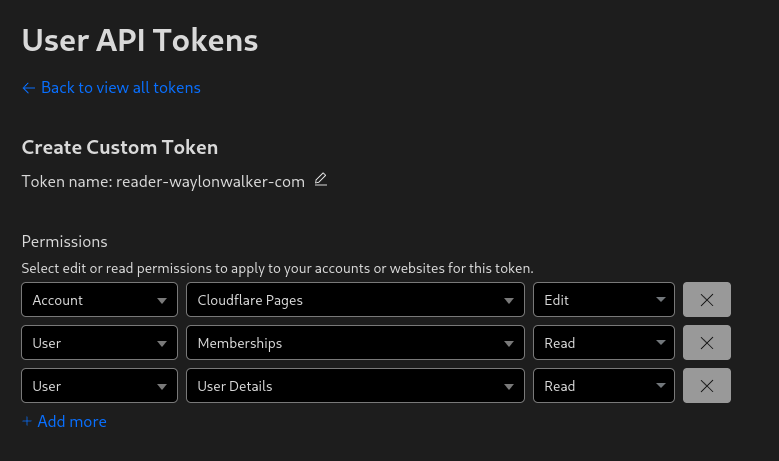
Before deploying to cloudflare pages with wrangler you need a cloudflare api token. You can get one at dash.cloudflare.com/profile/api-tokens.
Install Wrangler #
Next install wrangler using npm.
npm i -g wrangler
Create a Project #
Before you deploy to cloudflare pages you need to create a project. You might already have one, or you might want to create one in the webui, but you have the option to create it at the command line with wrangler.
npx wrangler pages deploy markout --project-name reader-waylonwalker-com --branch markout
Deploy #
Now you can deploy your static application using wrangler to cloudflare pages.
In this example I have my application built into the markout directory, and since the production branch is named
markoutI need to pass that in here as well.
wrangler pages deploy markout --project-name reader-waylonwalker-com --branch markout
-
This is an interesting problem. I want to make a solution for this on htmx [1]-patterns. I would make user specific routes with an hx-get rather than serving the whole page, serve a partial with hx-oobs to fill in user specific data with a no cache on the cdn level.
References:
[1]: /htmx/
-
So cool to see ROX build this over the course of a day.
For my reader app I am using cronjobs to schedule my a new build and upload to
cloudflare pages every hour. In this example I have built a docker image
docker.io/waylonwalker/reader-waylonwalker-com and pushed it to dockerhub.
It uses a CLOUDFLARE_API_TOKEN secret to access cloudflare, and the
entrypoint itself does the build and upload.
apiVersion: v1
kind: Namespace
metadata:
  creationTimestamp: null
  name: reader
  namespace: reader

---
apiVersion: batch/v1
kind: CronJob
metadata:
  name: reader-cronjob
  namespace: reader
spec:
  schedule: "0 * * * *"
  successfulJobsHistoryLimit: 6
  failedJobsHistoryLimit: 6
  jobTemplate:
    spec:
      template:
        spec:
          containers:
            - name: reader-container
              image: docker.io/waylonwalker/reader-waylonwalker-com:latest
              env:
                - name: CLOUDFLARE_API_TOKEN
                  valueFrom:
                    secretKeyRef:
                      name: cloudflare-secret
                      key: cloudflare-secret
          restartPolicy: OnFailure
Looking for inspiration? DigitalHarbor [1] by DigitalHarbor7 [2].
No description available.
References:
[1]: https://github.com/DigitalHarbor7/DigitalHarbor
[2]: https://github.com/DigitalHarbor7
I’m really excited about fastapi-observability [1], an amazing project by blueswen [2]. It’s worth exploring!
Observe FastAPI [3] app with three pillars of observability: Traces (Tempo), Metrics (Prometheus), Logs (Loki) on Grafana through OpenTelemetry and OpenMetrics.
References:
[1]: https://github.com/blueswen/fastapi-observability
[2]: https://github.com/blueswen
[3]: /fastapi/
I am working on a page for htmx-patterns and I ran into a situation with lots of duplication. Especially when i am using tailwind I run into situations where the duplication can get tedious to maintiain. The solution I found is macros.
Now I can use the same code for all of my links, and call the macro to use it.
{% macro link(id, text, boosted=false) -%}
<a
    class="
    {% if id is none %}
      pointer-events-none bg-terminal-950 text-terminal-900 ring-terminal-900
    {% else %}
      bg-terminal-950 hover:bg-terminal-900 hover:text-terminal-400 text-terminal-500 shadow-lg shadow-terminal-300/20 hover:shadow-terminal-300/30 ring-terminal-300
    {% endif %}
      cursor-pointer block text-center font-bold py-2 px-4 rounded w-full ring-1
    "
    {% if id is not none %}
    href="{{ url_for('boosted', id=id) }}"
    {% endif %}
    {% if boosted %}
    hx-boost="true"
    {% endif %}>
    {{ text }}
</a>
{%- endmacro %}

<h2 class='text-3xl font-light mt-0 max-w-xl text-center prose-xl mt-8 text-terminal-500'>
    Boosted Links
</h2>

<div class='flex flex-row gap-4'>
    {{ link(prev_id, 'Previous', boosted=True) }}
    {{ link(next_id, 'Next', boosted=True) }}
</div>

<h2 class='text-3xl font-light mt-0 max-w-xl text-center prose-xl mt-8 text-terminal-500'>
    Normal Links
</h2>

<div class='flex flex-row gap-4'>
    {{ link(prev_id, 'Previous', boosted=False) }}
    {{ link(next_id, 'Next', boosted=False) }}
</div>
If you’re into interesting projects, don’t miss out on taipy [1], created by Avaiga [2].
Turns Data and AI algorithms into production-ready web applications in no time.
References:
[1]: https://github.com/Avaiga/taipy
[2]: https://github.com/Avaiga
jinja has a loop variable that is very handy to use with htmx. Whether you want to implement a click to load more or an infinite scroll this loop variable is very handy.
{% for person in persons %}
<li
{% if loop.last %}
    hx-get="{{ url_for('infinite', page=next_page) }}"
    hx-trigger="intersect once"
    hx-target="#persons"
    hx-swap='beforeend'
    hx-indicator="#persons-loading"
{% endif %}
    {{ person.name.upper() }} -
    {{ person.phone_number }}
</li>
{% endfor %}
Now for every chunk of contacts that we load we will trigger the infinite scroll by loading more once the last one has intersected the screen.
Out of the box FastAPI.">Starlette does not support url_for with query params. When trying to use url_for with query params it throws the following error.
starlette.routing.NoMatchFound: No route exists for name "infinite" and params "page"
In my searching for this I found starlette issue #560 quite helpful, but not complete, as it did not work for me.
import jinja2

if hasattr(jinja2, "pass_context"):
    pass_context = jinja2.pass_context
else:
    pass_context = jinja2.contextfunction

@pass_context
def url_for_query(context: dict, name: str, **params: dict) -> str:
    request = context["request"]
    url = str(request.url_for(name))
    if params == {}:
        return url
    from urllib.parse import parse_qs, urlencode, urlparse, urlunparse

    # Parse the URL
    parsed_url = urlparse(url)

    # Parse the query parameters
    query_params = parse_qs(parsed_url.query)

    # Update the query parameters with the new ones
    query_params.update(params)

    # Rebuild the query string
    updated_query_string = urlencode(query_params, doseq=True)

    # Rebuild the URL with the updated query string
    updated_url = urlunparse(
        (
            parsed_url.scheme,
            parsed_url.netloc,
            parsed_url.path,
            parsed_url.params,
            updated_query_string,
            parsed_url.fragment,
        )
    )

    if os.environ.get("ENV") in ["dev", "qa", "prod"]:
        updated_url = updated_url.replace("http", "https", 1)

    return updated_url

def get_templates():
    templates = Jinja2Templates(directory="templates")
    templates.env.globals["url_for"] = url_for_query
    return templates
https
If you want url_for to work in production you need some way to convert http
to https. Here is how I make it work, for local development I export ENV=local then for each environment that I am running on a server I include
it in the list and update ENV appropriately.
    if os.environ.get("ENV") in ["dev", "qa", "prod"]:
        updated_url = updated_url.replace("http", "https", 1)
The route might look something like this.
@infinite_router.get("/")
async def home(request: Request, page: int = 1, n: int = 10):
  ...
To access the home route using url_for in a jinja template you can use the
following, once you have applied the url_for_query function as your default
url_for
<a href="{{ url_for('home', page=1) }}">Home</a>
Kind (Kubernetes in Docker) is a tool that makes it easy to create and tear down local clusters quickly. I like to use it to test out new workflows.
Argocd is a continuous delivery tool that makes it easy to setup gitops workflows in kubernetes.
Here is how you can setup a new kind cluster and install argocd into it using helm, the kubernetes package manager.
kind create cluster --name argocd

# your first time through you need to add the argocd repo
helm repo add argo https://argoproj.github.io/argo-helm
helm repo update

# install argocd into the cluster
helm install argo argo/argo-cd --namespace argocd --create-namespace

# deploy the app of apps
kubectl apply -f apps/apps.yaml
If you want to add repos and apps to your cluster you can use the argo cli to do that, but first you will need forward the argocd port and login.
# Wait until Argo CD API server is available
echo "Waiting for Argo CD API server to be available..."
while ! kubectl wait --for=condition=available --timeout=60s deployment/argo-argocd-server -n argocd; do
  echo "Waiting for Argo CD API server to be ready..."
  sleep 10
done


kubectl port-forward svc/argo-argocd-server -n argocd 8080:443 &
argocd_admin_password=$(kubectl get secret argocd-initial-admin-secret -n argocd -o jsonpath="{.data.password}" | base64 -d)
argocd login localhost:8080 --insecure --username admin --password $argocd_admin_password
argocd repo add https://github.com/fokais-com/app.fokais.git --username waylonwalker --password ${GH_ARGO_PAT}
argocd app create app-fokais-local --repo https://github.com/fokais-com/app.fokais.git --path k8s/overlays/local --dest-server https://kubernetes.default.svc --sync-policy automated --sync-option Prune=true
Hogwarts Legacy Argyllshire map: What does the button do?
Only one spell can be used to grant you entry.
Dot Esports · dotesports.com [1]
Damn this button had me stuck for way too long. It definitely looks like a button once I see it, but I don’t recall coming into contact with many buttons in the game, I tried to set it ablaze, pull it, fly it, nothing.
References:
[1]: https://dotesports.com/hp/news/hogwarts-legacy-argyllshire-map-what-does-the-button-do