The beautiful sentence that is the web A metaphor for the building blocks of web development. cassidoo.co Nicely worded Cassidy! Javascript can be too much, it can bog down low powered devices, we can ship so much that its untenable on poor connections. It can be argued that its a bad language and putting it on the server is a mistake, but it brings sites to life. It makes it possible to extend the static nature of html /css with just a little special spice only your site needs. I’d add to the argument that a lot of js should go away over time. Over time libraries such as jquery have fallen out of use, not because they are bad, or have been replaced by new libraries, but because the browser has adopted most of the functionality that jquery brought. As a primarily python dev I’d really like to see htmx die a very similar graceful death. There have been several iterations on this idea, and the crux of it is very similar, give the ability to use HTTP verbs right inside html with some instruction of when to apply them and what to apply them to. No js should not go away, it never will, we will always find new patterns that the browser should take, sites will always need a small bit of s…
Posts tagged: webdev
All posts with the tag "webdev"
214 posts
latest post 2026-07-05
Publishing rhythm
External Link stackoverflow.com Today I learned how to configure the baseurl for htmx using the tag. This is pretty handy to be able to configure different baseurls.
Addy Osmani (@addyosmani.bsky.social) Tip: Chrome DevTools can override the content of Fetch/XHR requests! Useful for mocking APIs without waiting on backend changes. Bluesky Social · bsky.app WTF, you can just change a server response from devtools and update a vuejs app? Just tried with htmx, and my GET requests are not showing up in the sources tab. I’ll keep this in my back pocket for next time I’m supporting a vuejs app though.
Great list of 4 tips for running fastapi applications. Keep routes small # Fat routers with all of the logic built in makes them hard to test, hard to refactor, causes lots of duplication, and makes it hard to reuse the business logic code later in something like a cli application. Deploy Early # I really like this advice! He reccommends deploying as early as you can get a healthcheck live in your application. I’ve found too many times developers build something that is really hard, or impossible to deploy, when if they had tried to deploy early they would have spotted some easy to fix issues. This is less important if you are building out of a template that your team commonly deploys from, but very important with new patterns. https://youtu.be/XlnmN4BfCxw?si=ks1wvmgDyoQLgrv2&t=1093
thoughts 0.0.4
This is such an improvement to the backend of my website it warrants a blog post of celebration. For far too long I’ve been dealing with a tiny ass edit form on thoughts. I tend to not edit them, and try to get them right in one go. This is kinda the point of a thought, its a quick post meant to be the size of a tweet, but sometimes I’m leaving thoughts on a video or long post and want to make sure I have a good save point, but I just keep the thing in draft and hope I don’t loose if for far too long. Results # Let’s see this change in action!! before # This is the tiny ass form nested deeply in the flow of the feed. When I made it I naively just swapped out the post itself with the edit form, and swapped the post back in after edit. after # Now the edit is a full page modal with a nice blurry backdrop effect to the rest of the content. This feels pretty similar to making a on twitter. How # How did I do this with htmx? I had to break out of the mindset my brain was in with swapping in…
Reminder to tune in later, can’t watch now, but saw a link on Dave’s blog.
Today i got hit by this accessibility issue on my site. Low contrast links are not distiniquishable. I had not seen this error title before it was new to me, maybe I have bad memory or maybe it’s new to me.
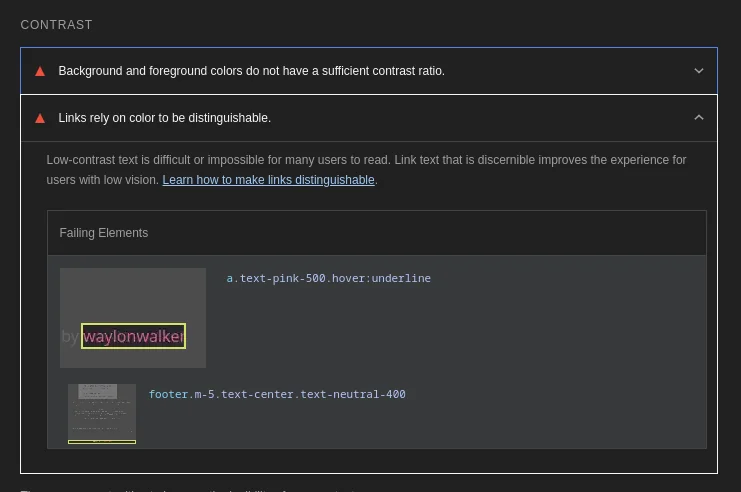
I ended up dropping the background color of the site down a notch as I didn’t
really care for the semi-dark brown anyways. I’m liking the near black
bg-zinc-950 much better now.

Now I got that 100 A11y score in lighthouse.

Add a healthcheck to your FastAPI app | Nic Payne I'm building a few FastAPI apps to throw in docker and run on my homelab... I wanted to add healthchecks and here's a simple way to do it Make sure to pype.dev Nice example of adding a healthcheck to fastapi, and integrating it with docker. Don’t forget to include curl in the install, nice touch.
Hurl - Run and Test HTTP Requests Hurl, run and test HTTP requests with plain text and curl. Hurl can run fast automated integration tests. hurl.dev Hurl was mentioned by @gerhard on the latest changelog and Friends. Looks like a feature rich easy to use testing tool that is tested via what looks like a config file. Hurl is a command line tool that runs HTTP requests defined in a simple plain text format. It can chain requests, capture values and evaluate queries on headers and body response. Hurl is very versatile: it can be used for both fetching data and testing HTTP sessions. Hurl makes it easy to work with HTML content, REST / SOAP / GraphQL APIs, or any other XML / JSON based APIs.
Wes Bos (@wesbos) on X CSS Anchors: flip a tooltip to the bottom when it goes offscreen X (formerly Twitter) · x.com These css anchors are crazy that you can do this with html and not a bunch of js, probably requiring a library or framework.
External Link uxplanet.org A nice set of blacks to use in web design. Subtle variants off of black or white like this can really make your design look nice and modern.
Wes Bos (@wesbos) on X Are you using position: absolute; to overlap elements? It's almost always better to Use CSS Grid instead! X (formerly Twitter) · x.com This is a pretty incredible use of css grid to overlay items overtop of each other without needing to resort to and the side effects that it brings.
Buttery.so Buttery smooth, minimal icons for interfaces. buttery.so Some sick looking icons no attribution needed.
A slug is the part of the url that comes after the domain. Commonly matches the file name of a markdown file many blogging systems. These are typically human readable, unique identifiers for pages within the site.
External Link stackoverflow.com today I learned that there is an accessibility feature in chrome that allows you to place a text cursor anywhere on the page. I had accidentally done this and it drove me mad that it was there.
External Link fullystacked.net You can explicitly make a script render blocking, nothing will be rendered until this js is ready.
FastHX - FastHX volfpeter.github.io Very interesting approach to htmx and fast api. It uses separate decorators for returning template partials and json that can be stacked to include both options on a single route. The templates are explicitly set in the decorator. Separate decorators are used for full page and partial pages. I don’t see an example of full and partial pages being combined. I think the demo app must be behaving in a spa like fashion where it does not get all of the data when it calls index and index will ask for user-list. Definitely going to keep my eye on this project and ponder on it.
FastHX - FastHX volfpeter.github.io Very interesting approach to htmx and fast api. It uses separate decorators for returning template partials and json that can be stacked to include both options on a single route. The templates are explicitly set in the decorator. Separate decorators are used for full page and partial pages. I don’t see an example of full and partial pages being combined. I think the demo app must be behaving in a spa like fashion where it does not get all of the data when it calls index and index will ask for user-list. Definitely going to keep my eye on this project and ponder on it.
Background Tasks - FastAPI FastAPI framework, high performance, easy to learn, fast to code, ready for production fastapi.tiangolo.com fastapi comes with a concept of background tasks which are functions that can be ran in the background after a function has been ran. This is handy for longer running functions that may take some time and you want to have fast response times. Here is an example from the docs
Supply chain attacks are so big these days engineers definitely need to take these into consideration. It’s wild that such a simple attack vector hit some really big applications. This particular vector is so easy to avoid. You are already hosting web content, just curl the file and self host the script, then you own it. That eliminates this attack vector all together, but doesn’t completely remove supply chain attacks, the js file can still hit external apis internally. What I see has happened in this case is that the owner of the domain polyfill.io changed. so anyone who directly linked to them got a malware injected script used. I can only imagine the number of applicatons that are not even being maintained anymore getting hit by this. TLDR, if you are taking something to production, where you are goind to deploy it and let it run, host the js yourself. these cdns are great for prototyping, but tread with caution.